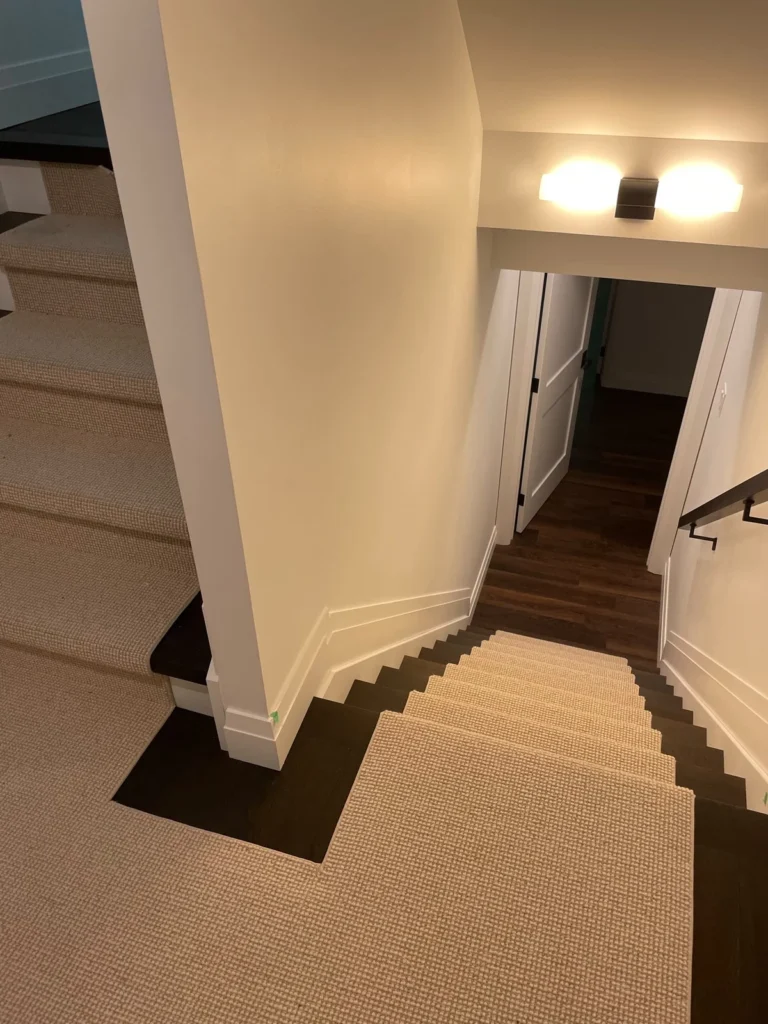
Engineered hardwood flooring in Potomac, MD gives you a real wood surface that handles a Maryland summer better than solid plank. We check the wear layer, flatten the subfloor, and glue down, float, or staple to suit the room. Potomac Carpets works out of Potomac, MD across Montgomery County.
Wear layer measured in mils
Glue-down, floating, or stapled
Reducers and stair nosing fitted
Get an Engineered Hardwood Quote
Tell us the rooms, what is on the floor now, and the wood look you want.
Prefer to call? +1 240 751 5542
What We Check on an Engineered Job
The wear layer
We read the spec sheet for the veneer thickness in mils. That number decides whether the floor can ever be sanded.
The subfloor
We check plywood for flatness and squeaks, and slabs for moisture. Low spots get self-leveller before a plank goes down.
How it attaches
Glue-down, floating click-lock, or staple. The core, the subfloor, and the room all point to one of the three.
Where it stops
Doorways, stair nosing, reducers to carpet, the toe kick under cabinets, and the door swing all get measured first.
Wood meets stairs
Plan the Landing Before the First Plank
Engineered plank usually meets carpet somewhere, and the stairs are where it shows. We set the finished floor height first, then pick the stair nosing so the top tread sits level with the plank instead of standing proud of it. If a runner is going down the stairs, we match the wood tone to the binding and keep the reducer at the doorway low and tight. Ask us to price the wood and the runner together.
We check sunlight, pets, kids, and which floors join up, then narrow the samples to what will survive.
2
Test the subfloor
We measure flatness with a straightedge and moisture in the slab or plywood before we commit to a method.
3
Acclimate the wood
Boxes sit in the room, opened, until the plank matches your house. Skipping this is why floors gap in January.
4
Lay it and trim it
We run the boards, hold the expansion gap at the walls, then fit reducers, stair nosing, and transition strips.
The Three Numbers That Matter
Wear layer in mils
A 6 mil veneer will never be sanded. A 3 mm layer takes one or two passes. Ask the number before you fall for the color.
Core and method
A plywood core takes staples or glue. An HDF core with click-lock usually floats over underlayment. The core picks the method.
Board width
Wide plank looks calmer in a big room and moves more with humidity. We glue wide boards down rather than float them.
What Our Customers Say
Reviews shared with us directly by Potomac Carpets customers.
★★★★★
5/5
Potomac Carpets did an excellent job from start to finish. The team was professional, punctual, and helped us choose the perfect carpet for our home. The installation looks fantastic!
★★★★★
5/5
Great service and quality workmanship. The installers were friendly, efficient, and left everything clean when they finished. I highly recommend Potomac Carpets.
★★★★★
5/5
We had a wonderful experience with Potomac Carpets. They offered a great selection, answered all our questions, and completed the installation on time. Our new flooring looks beautiful.
★★★★★
5/5
Professional, reliable, and easy to work with. The entire process was smooth, and the finished result exceeded our expectations. We would definitely use Potomac Carpets again.
Two samples can look alike and behave nothing alike
Put two oak planks side by side and you cannot tell them apart. One has a 6 mil veneer glued to a fiberboard core. The other has a 3 mm sawn top over plywood. The first is finished when the finish wears through. The second can be sanded and stained twenty years from now. Ask for the wear layer number, in mils or millimeters, before you fall in love with a color.
The core matters just as much. Plywood cores take staples and glue. HDF cores with a click-lock edge are built to float over underlayment. If you already have wood down and it is solid, hardwood floor refinishing may cost less than replacing it.
Match the plank to your subfloor
We check the subfloor before we quote a method. On plywood we run a straightedge, screw down the squeaks, and sand off ridges. On a slab we take a moisture reading and flatten low spots with self-leveller. Then we pick between glue-down, floating over underlayment, and stapling.
Wide boards get glued. A 7 inch plank floating over foam moves and telegraphs every dip. Then the wood sits in your house, boxes open, until it matches the humidity of the room. That acclimation step is why floors gap in January, and it costs nothing but patience.
Settle the doorways before you order
Engineered wood almost always meets something else. Carpet in the bedrooms, tile in the bath, a stair landing at the top of the flight. Each junction needs a reducer, a transition strip, or a stair nosing, and each one has a height. We measure the finished heights together so no doorway ends up with a lip you catch your toe on.
No. The top of an engineered plank is real sawn wood over a plywood or HDF core. Laminate is a printed photo under a plastic wear layer. You can sand some engineered floors; you can never sand laminate.
Can it go over a basement slab?
Usually yes, and that is engineered wood's advantage over solid plank. We test the slab for moisture, put down a moisture barrier or a moisture-blocking adhesive, and flatten anything out of tolerance first.
Will it ever be refinishable?
That depends entirely on the wear layer thickness. Around 3 mm or more gives you a sanding or two. Thin veneers can be screened and recoated but not sanded to bare wood. We tell you which one you are buying.
Glue-down or floating?
Glue-down feels solid underfoot and stays put under wide boards. Floating goes faster and works well over a subfloor we do not want to fasten into. The product spec and your subfloor decide, not preference alone.
Compare Wood & Flooring Services
Hardwood Flooring Installation in Potomac, MD
Hardwood flooring installation in Potomac, MD begins under the boards.
Luxury vinyl plank flooring in Potomac, MD takes dogs, dropped toys, and wet boots. We match wear layer and core to each room, flatten the subfloor, then click or glue the planks down.