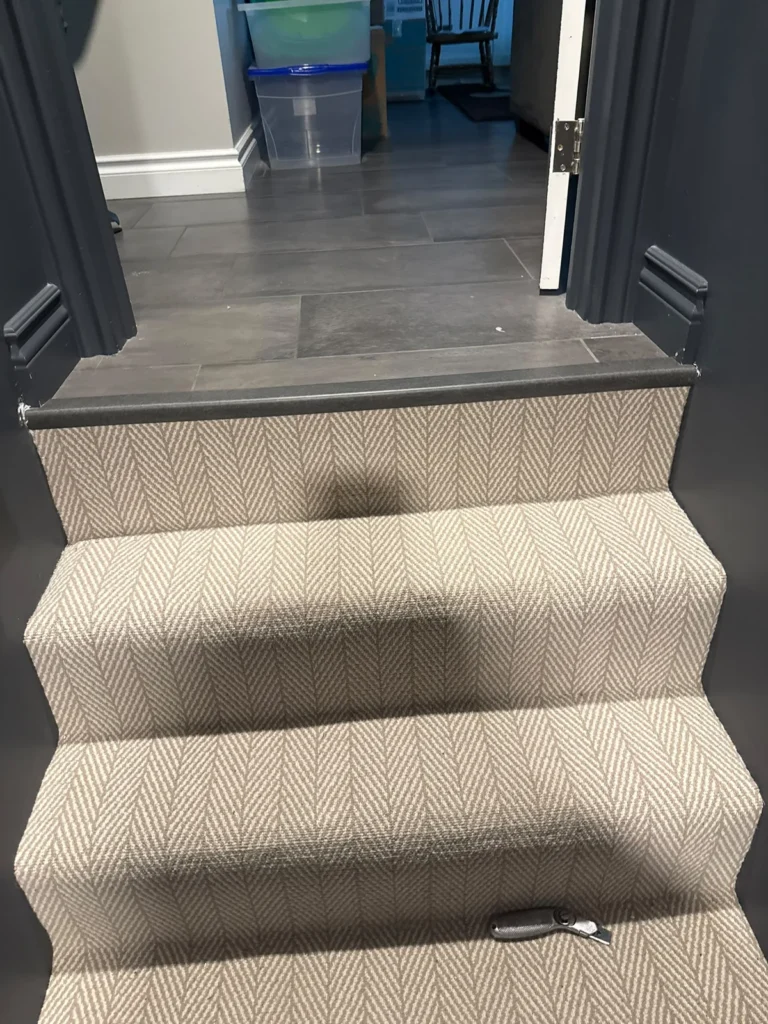
Stair runner installation in Potomac, MD leaves your wood showing on both sides. We measure every tread, center the runner on the stair, and fit it waterfall or cap-and-band by hand. Potomac Carpets works out of Potomac, MD across Montgomery County.
Waterfall or cap-and-band
Bound or serged edges
Winders and landings templated
Request a Stair Runner Quote
Tell us how many steps, whether the stairs turn, and the runner look you want.
Prefer to call? +1 240 751 5542
What We Record on Your Staircase
Every tread and riser
We measure each step, not the first one times fourteen. Depths and heights drift, especially in older houses.
Runner width
We center the runner and set how much wood stays visible on each side, usually three to five inches.
Winders and landings
Turning steps get their own template. Each one is a wedge, and no two are the same wedge.
Edge finish
Bound, serged, or a woven border. We tell you what each does to the look and the lead time.
THE DETAIL AT THE NOSING
Where a runner shows its work
Look at the front edge of a tread. On a waterfall the carpet rolls over the nosing and drops straight to the next step. On a cap-and-band it wraps the nosing tight and tucks into the crotch where the riser meets the tread. Cap-and-band takes longer and looks sharper, especially on a stained handrail staircase. We fit either one by hand, step by step. Call +1 240 751 5542.
We measure every tread, riser, winder, and landing and write each one down.
2
Set width and style
You choose the runner width, the edge finish, and waterfall or cap-and-band.
3
Prep the wood
We pull old tack strip and staples, check for loose treads, and clean the exposed wood.
4
Fit step by step
Pad on the treads, tack strip in the crotch, runner stretched and fastened at each step.
Choices That Change a Runner
Waterfall or cap-and-band
Waterfall drops straight off the nosing and goes faster. Cap-and-band wraps the nosing and reads tailored.
Edge finish
Serged edges look hand-sewn and slim. Cotton or linen binding gives a crisp tape border along both sides.
Turns and winders
Every winder is a separate wedge, cut and fit on site. They are the reason two staircases never price the same.
What Homeowners Tell Us
Reviews shared with us directly by Potomac Carpets customers.
★★★★★
5/5
Potomac Carpets did an excellent job from start to finish. The team was professional, punctual, and helped us choose the perfect carpet for our home. The installation looks fantastic!
★★★★★
5/5
Great service and quality workmanship. The installers were friendly, efficient, and left everything clean when they finished. I highly recommend Potomac Carpets.
★★★★★
5/5
We had a wonderful experience with Potomac Carpets. They offered a great selection, answered all our questions, and completed the installation on time. Our new flooring looks beautiful.
★★★★★
5/5
Professional, reliable, and easy to work with. The entire process was smooth, and the finished result exceeded our expectations. We would definitely use Potomac Carpets again.
Measure every tread, because they are not twins
Stairs look uniform from the bottom. They almost never are. The bottom step usually runs deeper than the rest, the top riser often comes up short, and a house that has settled will drift a quarter inch from step to step. Add a winder or a mid-flight landing and the geometry changes again, since each turning step is a wedge with its own two edges.
So we write down every tread depth, every riser height, and the width at several points. That sheet drives the yardage and the cut list. A quote built on step count times one guessed dimension will be wrong, usually short. For carpet that covers the full stair and continues into the rooms, see residential carpet installation.
Waterfall or cap-and-band changes the whole look
Waterfall lets the runner roll over the nosing and fall straight down to the next tread. It is quick, it suits a plain modern stair, and it leaves a small void behind the riser. Cap-and-band wraps the carpet over the nosing and pulls it tight into the corner where the riser meets the tread. You see the stair profile through the carpet, and the job reads tailored.
Cap-and-band costs more because it is slower, step by step. On a stained oak staircase with a visible profile, it is usually worth it.
Bound edges and what actually holds it down
The runner gets finished on both long edges before it reaches your house: serged for a slim hand-sewn look, or bound with cotton or linen tape for a crisp border. Then we fit it. Pad goes on the treads only, tack strip sets in the crotch of each step, and the runner is stretched over both and fastened tight so nothing shifts underfoot.
Rarely. The bottom step is often deeper, the top riser often shorter, and older houses drift a quarter inch step to step. We measure each tread and riser and cut to those numbers. Assuming they match is how a runner ends up crooked by the landing.
How wide should the runner be?
Most staircases look right with three to five inches of wood showing on each side. We center on the actual stair, not on the wall, since the two are seldom parallel. Wider stairs can carry a wider runner without looking heavy.
What is the difference between waterfall and cap-and-band?
Waterfall lets the carpet fall straight from the nosing to the next tread, leaving a small gap behind. Cap-and-band wraps the nosing and pulls tight into the corner where riser meets tread. Cap-and-band takes more labor and shows the stair profile.
Can any carpet be used as a runner?
No. It has to bend over the nosing without grinning open at the back, so a stiff backing or a very loose loop can be a problem. Most cut pile and tight loop wool goods work well. The edges also need binding or serging, which adds time before install.
Related Stair and Carpet Work
Patterned Carpet Installation in Potomac, MD
Patterned carpet installation in Potomac, MD lives or dies on the repeat. We measure it, order the extra yardage matching eats, and set the pattern straight down your longest sightline.